Novel Plant Antimicrobial Peptides Offer Hope for Sustainable Control of Citrus Greening and Pierce’s Disease
Two of the most devastating plant diseases affecting U.S. specialty crops—Huanglongbing (HLB) in citrus and Pierce’s Disease (PD) in grapevines—continue to threaten the long-term viability of these industries. Together, they cost growers hundreds of millions of dollars each year due to tree and vine losses, reduced yields, increased management costs, and long-term declines in orchard and vineyard productivity.
HLB, caused by Candidatus Liberibacter asiaticus (CLas), has devastated citrus industries worldwide and is now widespread in Florida and present in California. Once a tree becomes infected, the disease is typically fatal. Similarly, Pierce’s Disease, caused by Xylella fastidiosa (Xf), disrupts the transport of water and nutrients in grapevines, leading to scorched leaves, shriveled fruit, and eventual vine decline. Outbreaks of PD remain a persistent concern across California’s winegrowing regions.
Both bacteria are transmitted by sap-feeding insects—the Asian citrus psyllid (ACP) in citrus and the glassy-winged sharpshooter (GWSS) in grapes. Because these pathogens reside within the plant’s vascular system, they are extremely difficult to treat once established. As a result, growers have relied heavily on insecticide-based vector management, often involving frequent applications of broad-spectrum products such as neonicotinoids. While effective at reducing vector populations, these chemicals can harm beneficial insects, pose health risks to humans and animals, damage the environment, promote the development of insecticide-resistant pests, increase production costs, and face growing regulatory scrutiny.
In the search for safer, more targeted disease management tools, researchers have turned to nature for inspiration. A promising discovery emerged from the Australian finger lime, a citrus relative known for its remarkable tolerance to HLB. Scientists identified a group of small molecules known as Stable Antimicrobial Peptides (SAMPs), which appear to contribute to the plant’s natural resilience. These peptides can directly kill the bacterial pathogens and induce plant immune responses, and are now being studied as potential tools to manage both HLB and Pierce’s Disease, offering growers a new, environmentally friendly option for disease control.
What Are SAMPs, and Why Are They Exciting?
SAMPs are small, stable antimicrobial peptides produced by plants. Unlike chemical pesticides, SAMPs are naturally produced in plants, and can be detected in fruits that people consume, indicating that they are safe to human and animals. Furthermore, they typically act on specific pathogens while having minimal effects on the surrounding environment.
1. SAMPs can control HLB in citrus trees
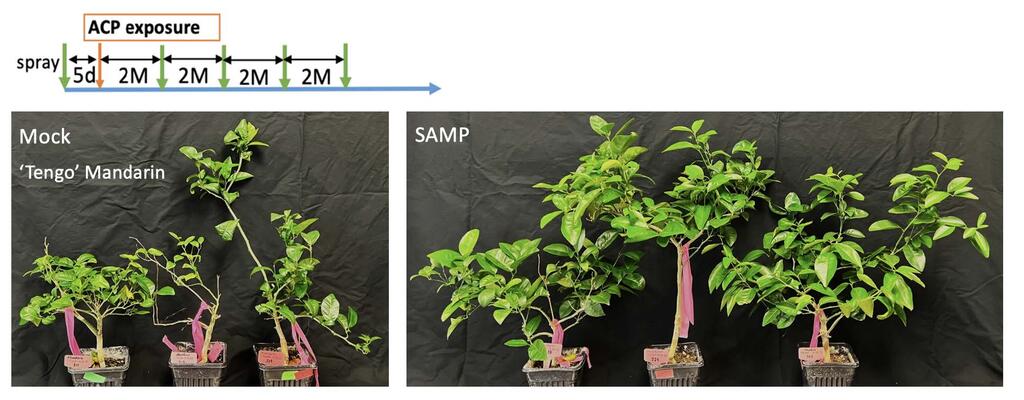
When applied to infected citrus trees, SAMPs significantly reduced CLas levels within plant tissues, resulting in improved plant health and slowed disease progression. These effects were observed in both preventive and curative treatments, indicating that SAMPs have the potential not only to protect healthy trees but also to help infected trees remain productive for extended periods. Figure 1 illustrates one such experiment in which nursery trees were treated with a foliar SAMP spray. SAMP-treated trees showed enhanced protection against CLas infection, leading to healthier growth, larger canopies, and little to no visible disease symptoms.
In studies examining the insect vector, the Asian citrus psyllid (ACP), we repeatedly observed trends toward reduced egg production, lower egg-to-nymph hatching rates, and decreased CLas titers in psyllids feeding on SAMP-treated citrus; however, these effects did not reach statistical significance. This variability likely reflects inconsistent exposure to the peptide during prolonged feeding periods, arising from differences in insect feeding behavior and the transient stability of foliar-applied SAMP under environmental conditions. To achieve more consistent exposure, future studies could employ stable engineered citrus trees that enable consistant endogenous expression of SAMP, thereby allowing a more rigorous evaluation of SAMP’s potential effects within the insect vector.

2. SAMPs also control Pierce’s Disease in grapes
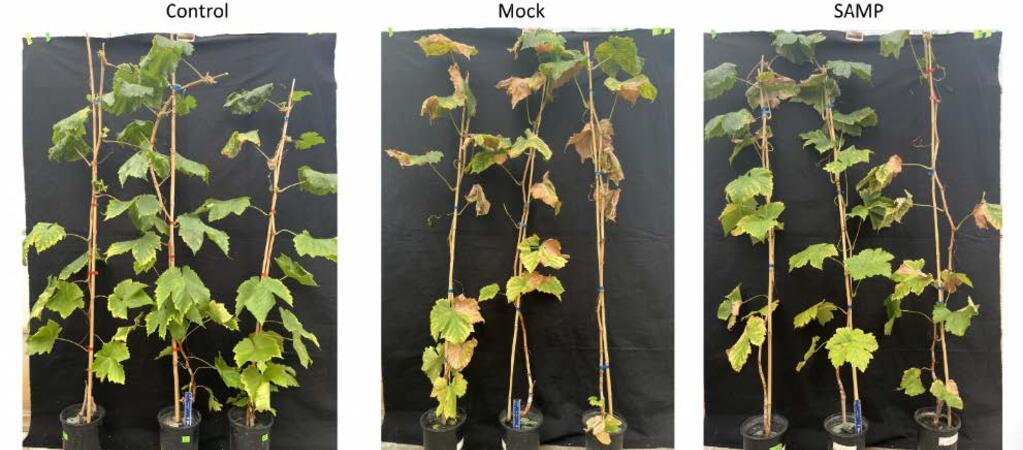
Our results in grapevines are equally encouraging. When applied to plants infected with Xylella fastidiosa, SAMP treatment significantly reduced bacterial levels in both leaf tissues and stems. This reduction was accompanied by visible improvements in plant vigor, fewer Pierce’s Disease symptoms, and a slower rate of disease progression.
We evaluated SAMP efficacy under two primary treatment scenarios:
Preventive treatments: Healthy grapevines were treated prior to bacterial exposure. These plants exhibited lower infection rates and delayed symptom onset, suggesting that SAMPs may enhance innate plant defenses or restrict bacterial establishment.
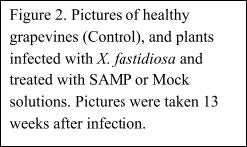
Curative treatments: Grapevines with established X. fastidiosa infections received SAMP applications. In these experiments, SAMP treatment slowed disease progression, reduced bacterial titers, and helped maintain healthier canopy growth compared with untreated controls (Figure 2).
While additional validation under field conditions is required, these greenhouse results strongly support the potential of SAMPs as a novel tool for managing Pierce’s Disease. Unlike many conventional approaches, SAMPs do not rely on killing insect vectors. Instead, they act within the plant to reduce bacterial populations, potentially lowering overall disease pressure and improving vine longevity without the ecological costs associated with routine insecticide use.
3. Implications for Integrated Pest Management (IPM)
SAMPs could substantially reduce reliance on broad-spectrum insecticides by providing a plant-targeted, low-impact alternative. They are likely compatible with existing biological control strategies and may help growers transition toward more sustainable pest management systems that align with evolving regulatory and environmental priorities.
A Path Toward Sustainable Crop Protection
Although further work is needed before SAMPs can be widely adopted in commercial orchards and vineyards, the results to date are highly encouraging. These naturally occurring peptides offer several key advantages:
- Specific targeting of bacterial pathogens
- Reduced ecological impact compared with broad-spectrum chemical controls
- Potential compatibility with environmentally friendly IPM programs
- New management options for diseases with limited effective treatments
As research continues, SAMPs have the potential to become an important component in the management of HLB and Pierce’s Disease, helping growers protect crop productivity while advancing more sustainable and resilient agricultural systems.